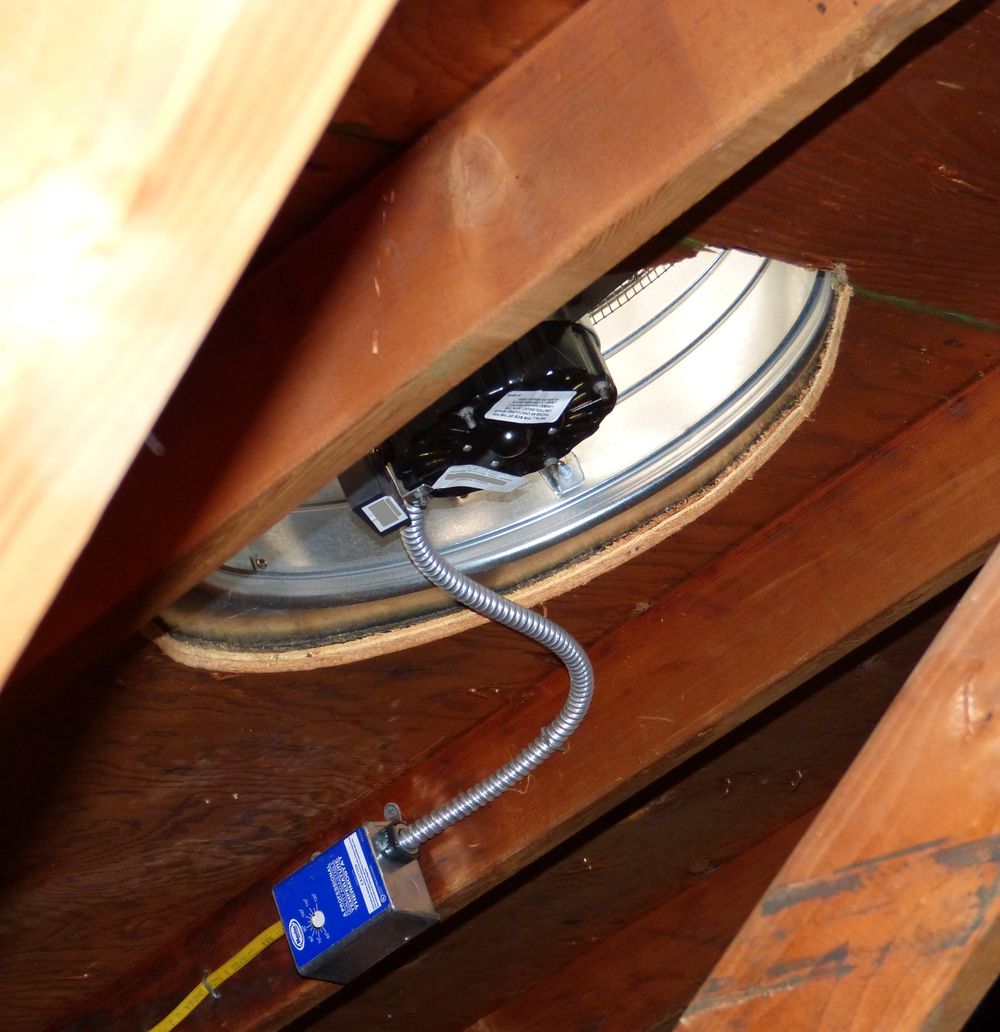
On a hot afternoon, the attic can be the hottest place in the house, and that heat presses down through the ceiling into the rooms below. A powered attic fan is one way to push that hot air out. Unlike a turbine vent that waits for the wind, a power gable mount attic fan runs on electricity and moves air on demand. This guide looks at a 1,600 CFM power gable mount attic fan: what the numbers mean, how the fan works, when it helps, and how to install and look after one.
An attic fan is an electric fan mounted in the attic to exhaust hot air. A gable mount fan sits on the inside of a gable end wall, behind a gable vent or louver, and blows air out through that opening. A power fan differs from a passive vent in one key way: it moves air whether the wind blows or not, and it moves a lot more of it. The motor, the blades, and usually a thermostat come as one unit, so the fan switches itself on when the attic gets hot and off when it cools down.
What 1,600 CFM means
CFM stands for cubic feet per minute. It is a measure of how much air the fan moves. A 1,600 CFM fan moves 1,600 cubic feet of air every minute when it runs at full speed. That is a large flow for a residential attic fan, suited to a good-sized attic.
To judge whether that flow fits your attic, think about the volume of the space. A fan that moves too little air for the attic will run for hours and barely change the temperature. A fan that moves far more air than the attic needs will pull hard on the house, and can draw conditioned air out of the living space through gaps around lights, wires, and attic hatches. That wastes the work of your air conditioner. The right size moves enough air to change the attic air regularly without pulling hard on the rooms below.
A common rule of thumb used by fan makers and contractors relates the fan's airflow to the attic floor area, with an allowance for a steep roof that holds more air. The exact figure varies by maker, and the roof shape, the climate, and the intake vents all matter. Ask your contractor to size the fan for your attic rather than picking a number from a chart on your own. If your attic is much larger than average, or the roof is very steep, a single fan may not be enough, and two fans or a different venting approach may serve you better.
How a gable mount fan works
The fan mounts on the inside of the gable end wall, in front of the gable vent opening. A shutter or louver on the outside lets air out and keeps rain and pests from coming in. When the fan runs, it pulls air from the attic and pushes it out through the vent. Replacement air comes in through the intake vents, usually the soffits under the eaves. The air travels up along the underside of the roof deck, picks up heat, and leaves through the fan.
Most power attic fans have a thermostat. You set a temperature, and the fan switches on when the attic reaches it and off when the attic cools below it. A common setting is somewhere in the range where the attic is clearly hot but not yet at its peak. Setting the thermostat too low makes the fan run all day, even when the attic is only mildly warm, which wastes power. Setting it too high means the fan starts late and the attic has already heated the rooms below.
Some fans also have a humidistat, which switches the fan on when the attic air is damp. That helps in winter, when moist air from the house can condense on the cold underside of the roof deck. A fan that runs on humidity as well as temperature helps keep the attic dry year-round, not just cool in summer.
When a powered attic fan helps, and when it does not
A powered attic fan helps an attic that gets very hot and has good intake ventilation. It is most useful in a hot climate, on a house with a large attic, dark roofing, and plenty of sun on the roof. It can lower attic temperatures on a still, hot day when a passive vent would barely move any air.
It does not help an attic with blocked intake vents. A fan can only exhaust the air that comes in somewhere. If the soffit vents are blocked by insulation, paint, or debris, the fan will pull air from wherever it can find it, and that is often the living space below, through gaps around recessed lights, attic hatches, and wire penetrations. Before installing a powered fan, clear the intake vents and seal the big air leaks between the attic and the rooms below. Sealing those leaks matters for its own sake, and it keeps the fan from stealing cooled air from the house.
A powered fan also does not replace insulation. If the ceiling has thin insulation, heat will press through it no matter how cool the attic is. A fan plus good insulation works far better than either one alone. And a fan will not fix a room that is hot because of a duct problem or a failing air conditioner. It cools the attic, and that is all it promises.
Installation notes
A gable mount fan is installed from inside the attic, which means working in a hot, cramped, dusty space. Most homeowners hire an electrician or a roofer for this job, and that is the right call for most people. The fan needs a power supply, a thermostat, and a secure mount, and all three need to be right.
The fan should mount flat against the gable wall, centered on the vent opening, with the blades clear of framing and wiring. The mount must be solid: a fan that vibrates against the wall will be noisy and will loosen its fasteners over time. Rubber mounts or isolation pads between the fan and the wall cut vibration and noise. The shutter or louver on the outside should open freely when the fan runs and close when it stops, so the attic is not left open to rain and pests all winter.
The wiring needs a dedicated circuit or a properly rated branch circuit, installed to local electrical code. The thermostat should sit where it reads the attic air temperature, not in a pocket of hot air near the roof deck or in the fan's own exhaust stream. A thermostat in the wrong spot will switch the fan on and off at the wrong times. If you are not comfortable with electrical work in an attic, hire a licensed electrician. Attic wiring mistakes are a fire risk, and they are not worth saving a service call.
Running costs and noise
A powered fan uses electricity every time it runs. A large fan running for many hours on a hot day uses a noticeable amount of power. That cost is worth it if the fan keeps the attic cooler and takes load off the air conditioner, but it is not free. A thermostat set sensibly, good intake ventilation, and a fan that is sized to the attic all keep the running cost down. A fan that runs all day because the thermostat is set too low, or because the intake vents are blocked and the fan cannot move air efficiently, wastes power.
Noise is the other running cost. The fan motor hums, the blades move air, and the sound carries into the rooms below if the mount is not isolated. A well-mounted fan with isolation pads is a background hum. A fan bolted straight to the framing can rattle the wall and annoy everyone in the nearest bedroom. If noise matters to you, ask about the fan's sound level and about mounting options that reduce vibration.
Maintenance and common problems
A powered attic fan needs a little regular care. Once a year, switch the power off and look at the fan from inside the attic. Check the blades for dust and damage, and clean them with a soft brush. Dust on the blades makes the fan less efficient and noisier. Check the motor for wear, and oil it if the maker says the bearings need oiling. Some motors have sealed bearings that need no oil; others have oil ports that need a few drops once a year.
Check the thermostat by watching when the fan starts and stops on a hot day. If the fan runs constantly, the thermostat may be set too low or may have failed. If the fan never starts, check the power supply and the thermostat setting before assuming the motor is dead. A tripped breaker or a loose wire is a cheaper fix than a new fan.
Check the shutter or louver on the outside each year. It should open when the fan runs and close when the fan stops. A shutter stuck open lets in rain and cold air all winter. A shutter stuck closed blocks the fan and makes the motor work against a closed door, which can burn it out. Clear any nests, leaves, or debris from the vent, and check the screen for holes.
In winter, think about whether the fan should run at all. A fan that runs on a cold day can pull warm, moist air from the house into a freezing attic, where the moisture condenses. If your fan has a humidistat, it will run when the attic is damp, which is helpful. If it only has a thermostat, it will stay off in cold weather, which is fine. Some homeowners cover the gable vent from the outside in winter to stop drafts, but check with your contractor before you do: sealing the attic completely can trap moisture inside.
Questions to ask your contractor
Ask how the fan size was chosen for your attic, and whether your intake vents can supply enough air for it. Ask whether the air leaks between the attic and the living space should be sealed first. Ask who will do the electrical work, and whether the circuit meets local code. Ask where the thermostat will go, and what temperature it will be set to.
Ask about the shutter, the mounting, and the warranty on the motor and on the installation. And ask what the fan will and will not do for your house. A good contractor will tell you plainly that a powered fan helps a hot attic with good intake air, but it does not replace insulation or fix a failing cooling system.
A 1,600 CFM power gable mount attic fan is a strong tool for a hot attic. It moves a lot of air on demand, it switches itself on and off, and it works on still days when a passive vent does little. Sized to the attic, fed by clear intake vents, wired properly, and given a yearly look, it can keep an attic cooler through the hottest months and drier through the damp ones. Get the intake air and the sealing right first, and the fan has something real to work with.