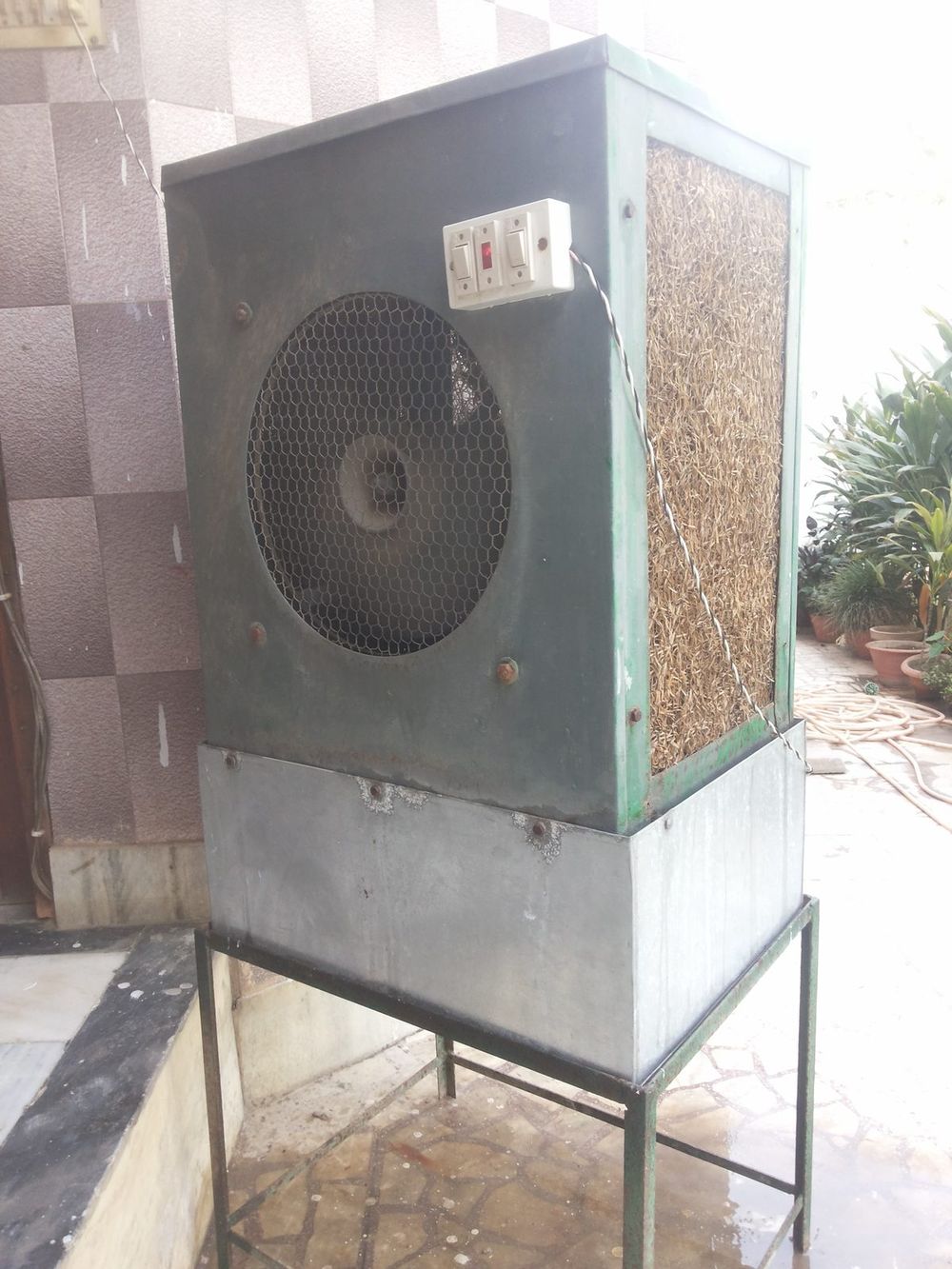
Does your workshop, garage, or patio feel unbearable on a dry summer afternoon, and is a fixed air conditioner out of the question? A portable evaporative cooler rated at 4,900 CFM, with the listing describing it as covering about 1,200 square feet, is the kind of unit that shows up for spaces like that. This guide explains how evaporative cooling works, what the airflow figure means, and how to use a portable unit well.
How Evaporative Cooling Works
An evaporative cooler, often called a swamp cooler, cools air by passing it through pads soaked with water. As the water evaporates from the pads, it absorbs heat from the air, so the air leaving the cooler is cooler than the air going in. A pump keeps the pads wet, a blower pushes the air through the pads, and the cooled air flows into the space. There is no refrigerant and no compressor, which is why evaporative coolers use far less electricity than a compressor-based air conditioner of similar airflow.
The catch is humidity. Evaporative cooling adds moisture to the air, so it is most effective in dry climates where the air can absorb that moisture. In a humid climate, the air is already close to saturated, so evaporation slows down and the cooling effect drops. A portable evaporative cooler is a good fit for a dry garage, a workshop, a warehouse bay, or a covered patio in a dry region, and a poor fit for a sealed, humid room.
What 4,900 CFM Means
CFM stands for cubic feet per minute, and it measures how much air the blower moves. A rating of 4,900 CFM means the cooler can move a large volume of air, which is what you need for a big open space. Airflow is the main capacity figure for an evaporative cooler, in the same way that tonnage is the main capacity figure for an air conditioner. More airflow cools a larger area, but only if the air has somewhere to go.
As a general rule of thumb, an evaporative cooler needs enough airflow to change the air in the space regularly, and many guides suggest sizing for a full air change every few minutes in a space you want to cool hard. That is a rough guide, not a specification for this unit, and the real result depends on the outdoor temperature, the humidity, the ceiling height, and how well the space is ventilated. Use the CFM figure to compare units against each other, and treat the coverage figure as the next section describes.
The Listing's Stated Coverage
The listing describes this cooler as covering about 1,200 square feet. Treat that as the seller's stated coverage, not a tested result for your space. Coverage claims for evaporative coolers assume a typical ceiling height, a dry climate, and good ventilation, and your space may differ on all three. A tall workshop with a metal roof in full sun will need more cooling than a shaded room of the same floor area, and a space with no exhaust path will not cool well no matter how much air the cooler moves.
Before you buy, measure the space you want to cool, note the ceiling height, and check how the air will leave. A portable cooler needs an opening, such as a partly open door or window, on the far side of the space so the cooled air can flow through and the warm air can escape. Without that exhaust path, the humidity builds up and the cooling effect fades. If the space is much larger than the stated coverage, or if it is divided into separate rooms, a single portable unit will not cool it evenly.
The Pneumatic Drive in the Listing
The listing describes this cooler as having a pneumatic drive. That wording comes from the product listing, and it is worth asking the seller or a contractor what drive arrangement the unit actually uses before you buy. Some portable coolers use a belt drive, some use a direct drive, and the drive type affects how the unit is serviced, what parts wear out, and how noisy it is. Ask for the manual or the parts list, and confirm which parts are replaceable and how the drive is adjusted or serviced.
Whatever the drive type, the service questions are the same. How do you reach the blower and the motor for cleaning? Are the pads easy to remove and replace? Is there a drain for the water tank, and how do you clean it? A portable cooler that is hard to open and clean will not get the maintenance it needs, and its performance will drop over a season.
Setting Up a Portable Evaporative Cooler
Start by placing the cooler where it can draw in fresh, dry outdoor air. A cooler that recirculates the same humid indoor air will not cool well, so put it near an open door or window and point the airflow into the space. Leave an exhaust opening on the opposite side so the air flows through the room instead of building up. Fill the water tank, check that the pump is wetting the pads evenly, and let the pads soak for a few minutes before you turn the blower to full speed.
Portable coolers have wheels and a handle for a reason: move the unit to where the people are. In a workshop, that might be near the workbench. On a patio, it might be near the seating area. Keep the cooler on level ground, keep the power cord out of walkways and water, and keep the air intake clear of dust and debris. If the cooler has a garden hose connection for continuous water, use it only where a leak will not damage anything, and check the connection for drips after the first hour.
Using It Well on a Hot Day
Evaporative coolers give you more when you start them before the space gets hot. Turn the cooler on in the morning, open the exhaust path, and let the cooled air keep the space from heating up in the first place. Once a concrete floor and walls have soaked up the afternoon heat, no portable cooler will bring the temperature down quickly. Run the blower on high while the space is in use, and lower it once the temperature is comfortable.
Watch the humidity. If the air starts to feel sticky, open the exhaust wider or run the cooler on the fan-only setting for a while. If the pads dry out, the cooler will blow warm air, so check the water level through the day, especially in very dry heat. In a workshop, keep paper, cardboard, and other moisture-sensitive materials away from the direct airflow, since the air leaving the cooler carries moisture with it.
Maintenance That Keeps It Cooling
Clean water is the foundation of maintenance. Drain the tank regularly, wipe it out, and refill with fresh water. Stale water grows algae and smells, and mineral deposits from hard water clog the pads and the pump. If your water is hard, expect to clean the tank and replace the pads more often, and consider a water treatment the cooler manual allows. Never add chemicals to the water unless the manual says they are safe for the unit.
Inspect the pads at the start of each season and during heavy use. Pads that are torn, matted, or crusted with minerals do not wet evenly, and the cooling drops. Replace them when they no longer hold water well. Clean the blower wheel and the air intake, check the drive and the belt if the unit has one, and oil any bearings the manual calls for. At the end of the season, drain the tank, clean the pads, dry everything, and store the cooler in a dry place with a cover.
Questions to Ask Before You Buy
Before you order, confirm the details that the listing does not spell out. What is the water tank capacity, and how long does it run before it needs a refill? How is the drive serviced, and which wear parts are available? What is the power draw and the cord length? What is the warranty, and who handles warranty service? Does the stated coverage assume a particular ceiling height or climate, and what does the seller suggest for a space like yours?
A 4,900 CFM portable evaporative cooler with a stated coverage of about 1,200 square feet is a serious piece of cooling equipment for a dry, open space. Match it to the space, give it fresh air and an exhaust path, keep the water and the pads clean, and it will do the job it was built for.