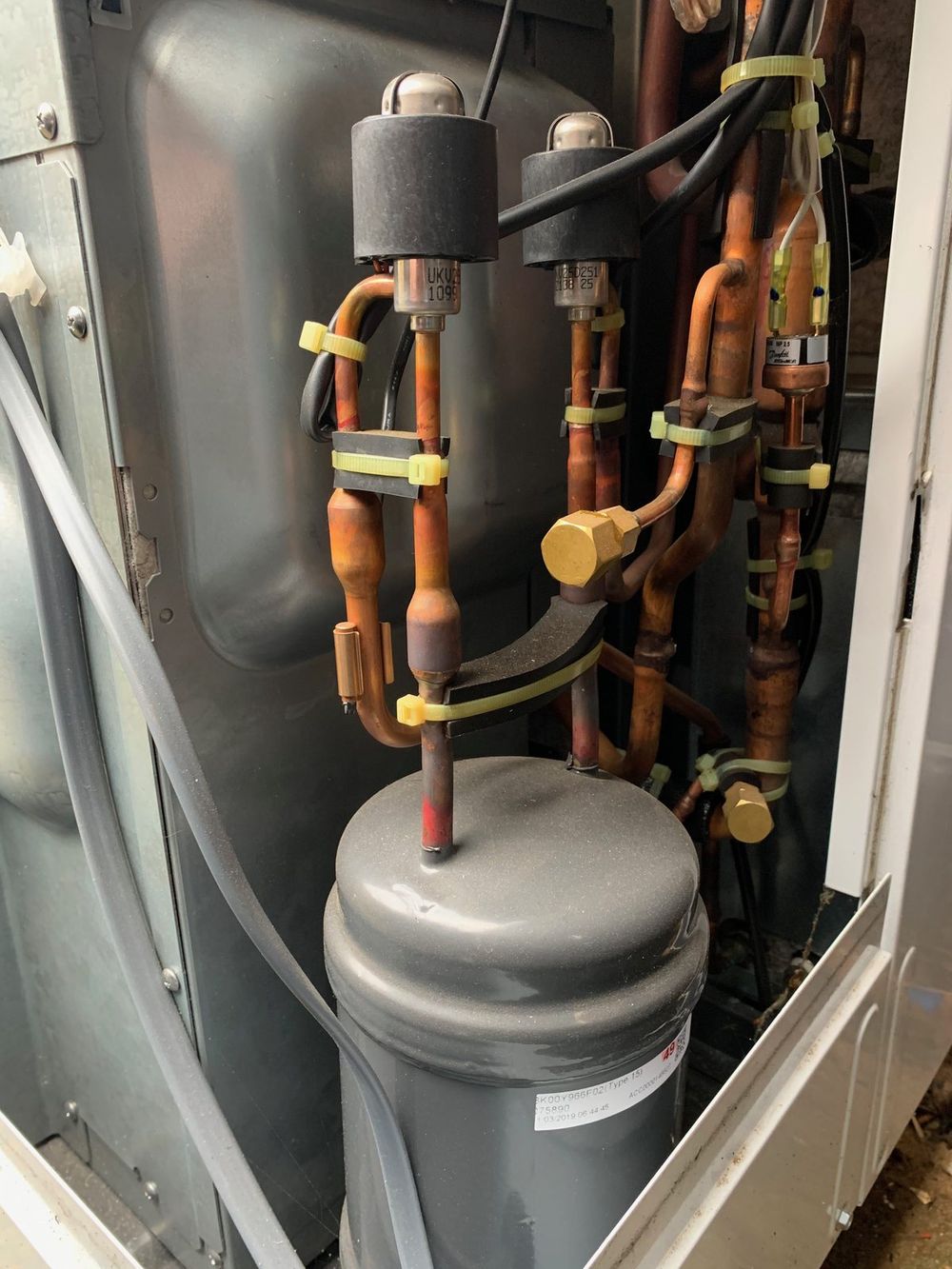
What is inside the box that cools your home? An air conditioner is a team of parts, and each one has a job: the compressor moves refrigerant, the coils exchange heat, the fan moves air, and the controls tell everything when to run. When one part fails, the whole system feels it. This guide walks through the main air conditioner parts, what they do, how they fail, and how to keep them working.
The Compressor: The Heart of the System
The compressor sits in the outdoor unit and pumps refrigerant through the system. It squeezes the refrigerant gas into a smaller volume, which raises its temperature and pressure so heat can be released outside. Then the refrigerant flows inside, expands, cools down, and absorbs heat from the house. The cycle repeats as long as the system runs.
A compressor is the most expensive part in most systems, and it usually fails from stress rather than age alone. Low refrigerant, a dirty coil, a failing capacitor, or an electrical problem can all force the compressor to work harder than it should. Warning signs include a humming outdoor unit that does not start, a unit that trips the breaker, or cooling that fades on hot days. A compressor that is loud, hot, or struggling deserves a technician visit before it stops entirely.
When a compressor fails in an older system, the repair decision is rarely simple. The part is costly, and the labor to replace it is real work. A technician can check whether the failure has sent debris through the lines, which would need cleaning before a new compressor goes in. In an older system with other worn parts, replacement of the whole unit is often the better value.
Coils: Where Heat Changes Hands
Two coils do the heat exchange. The evaporator coil sits indoors, usually above the furnace or inside the air handler, and absorbs heat from the air in the house. The condenser coil sits in the outdoor unit and releases that heat to the outside air. Both are made of thin metal fins over tubes, which gives them a large surface area in a small space.
Coils need clean surfaces and good airflow to work. A dirty indoor coil insulates itself with dust and cannot absorb heat well, which cuts cooling and can cause the coil to freeze. A dirty outdoor coil cannot release heat, so the system runs hotter and less efficiently. Keep the outdoor coil clear of leaves and grass, hose it gently from the inside out when it collects dirt, and change the filter on schedule so the indoor coil stays clean.
Refrigerant leaks often start at a coil. A leak lets refrigerant escape, which lowers cooling, raises running costs, and can damage the compressor. Signs include weak cooling, ice on the lines, a hissing sound near the unit, or an oily residue on the coil. A technician can find the leak, and the fix may be a repair or a coil replacement, depending on where the leak is and how old the coil is.
Fans, Blowers, and Motors
Fans move the air. The outdoor fan pulls air across the condenser coil, and the indoor blower pushes cooled air through the ducts. Each has a motor, and each motor has bearings that wear over time. A fan that wobbles, squeals, or stops is a common failure, and it is one that should not be ignored: an outdoor unit running without its fan will overheat fast.
Fan blades can bend or crack, and a bent blade will vibrate and wear the motor bearings. Keep the area around the outdoor unit clear so debris does not reach the fan, and listen for new rattles or squeals when the system starts. A blower that runs weakly may have a dirty wheel, a worn motor, or a failing capacitor. A technician can test the motor and the airflow and tell you which part is at fault.
Capacitors, Contactors, and Controls
Small electrical parts do big jobs. A capacitor stores a charge that helps a motor start and run, and a weak capacitor is one of the most common reasons a system hums but will not start. A contactor is a heavy-duty switch that connects power to the compressor and fan when the thermostat calls for cooling, and its contacts wear with every cycle. A control board runs the logic of the system, reading sensors and switching parts on and off.
Electrical parts fail from heat, age, and power surges. A swollen or leaking capacitor, a contactor with pitted contacts, or a board with a burnt spot are all visible signs a technician looks for. These parts are not safe for a homeowner to test without training, since the system carries high voltage even when the thermostat is off. Turn the power off at the breaker and the disconnect before you touch anything inside a unit, and call a technician if you are not sure the power is off.
Filters, Drains, and Refrigerant Lines
The filter protects the indoor coil and the blower from dust. A clogged filter cuts airflow, which can freeze the coil and overheat the blower. Check the filter monthly during heavy use and change it on the schedule the maker gives. The condensate drain carries away the water the coil pulls from the air, and a clogged drain can flood a ceiling or shut the system down through a float switch.
Refrigerant lines carry refrigerant between the indoor and outdoor units. The larger line carries cool gas back to the compressor and should be insulated along its full length, while the smaller line carries warm liquid to the indoor coil. Damaged insulation wastes energy and can let the line sweat, which drips water where it should not. Check the insulation each spring and replace any section that is cracked or missing.
Thermostats and Sensors
The thermostat reads the room temperature and tells the system when to run. A thermostat in a bad spot, such as in direct sun or near a heat source, will read wrong and cycle the system badly. Sensors inside the unit watch the coil temperature, the pressure, and the airflow, and they shut the system down to protect it when something goes wrong. A system that stops for no clear reason may be responding to a sensor that is doing its job.
If the system behaves oddly after a thermostat change, check the wiring against the photo you took before the swap, and confirm the thermostat settings match the system type. A heat pump needs different settings from a furnace and air conditioner pair, and a wrong setting can make the system heat when it should cool.
Buying Replacement Parts
When you need a part, match it exactly. A capacitor must match the rating printed on the old one, a filter must match the size printed on its frame, and a motor must match the speed and power ratings of the one it replaces. Bring the old part with you or take clear photos with the label in view. Buy from a supplier that lists clear specifications and a return policy, and keep the receipt and the old part until the new one is in and working.
Some parts are homeowner-friendly, such as filters, drain cleaner, and thermostat batteries. Others, such as capacitors, contactors, motors, and anything involving refrigerant, belong to a trained technician. The line is not about confidence but about safety and warranty: a wrong part can damage the system, and a repair done without the right tools can void a warranty. Know which side of the line a part falls on before you order it.
Keeping Parts Healthy
Most parts last longer with simple care. Change the filter, keep the coils clean, keep the drain clear, and book a yearly service visit. A technician will check the capacitor, the contactor, the refrigerant charge, and the airflow, and will spot a worn part before it fails on the hottest day of the year. Keep a record of the model and serial numbers, the filter size, and the parts that have been replaced, so any future repair starts from facts rather than guesses.
Air conditioner parts work as a team, and the system is only as strong as its weakest member. Learn what each part does, watch for the early signs of wear, and fix small problems while they are still small. That habit is what keeps a cooling system running through summer after summer.